Something shifted on the 6th June 2026. OpenAI switched on advertising inside ChatGPT for UK users, making the UK the first European market to receive the ChatGPT ads pilot, and one of only five territories in the world where it is currently live.
This is not a “coming soon” update. The ads are live. UK users on the Free and Go plans of ChatGPT are already seeing sponsored placements. And while most UK businesses cannot run a campaign just yet, the window to get ahead of this is open now and will not stay open for long.
Here is everything you need to know.
What Has Actually Happened?
On the 6th June 2026, OpenAI VP of Monetisation, Benji Shomair, confirmed the UK launch of ChatGPT advertising, making the UK the fifth geography to receive the pilot after the US (February 2026) and Canada, Australia and New Zealand (March 2026).
The UK is OpenAI’s first European ad market. Which is significant because it means the UK is being treated as a strategic priority in the global rollout, not an afterthought.
What is live right now:
- Sponsored placements are appearing inside ChatGPT for UK users on the Free and Go plans
- UK users with Plus, Pro, Business, Enterprise or Education subscriptions do not see ads
- Confirmed UK launch partners include fashion retailer Zalando and agency group Dentsu, running client campaigns across retail, hospitality, travel and more
What is not live just yet:
- There is no self-serve UK Ads Manager yet
- UK businesses cannot simply log in and launch a campaign the way they would with Google Ads or Meta
- Access currently runs through a direct relationship with OpenAI’s team, with interest registered online
This distinction matters. A lot of the coverage out there is treating these two things as the same: “ads are live for users” and “UK businesses can run ads.” They are not. The first is true. The second is still limited to a very small number of early partners. Understanding that gap is the whole point of this blog.
What Are ChatGPT Ads and How Do They Work?
For business owners who have not yet encountered one of these in the wild, here is a plain-English breakdown of how the format actually works.
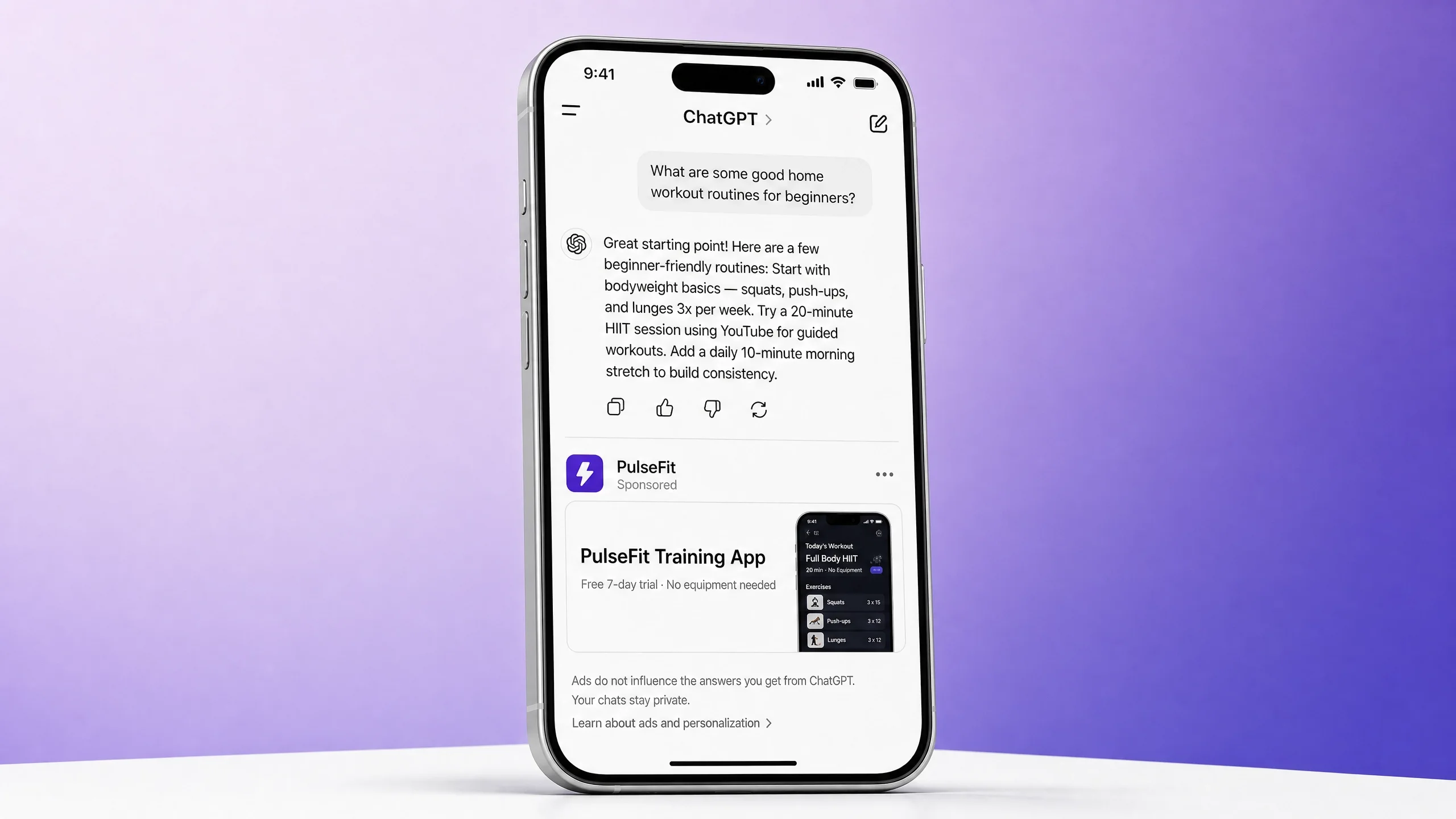
When a user on the Free or Go plan asks ChatGPT a question, a sponsored placement can appear directly below the AI’s organic response. The ad is clearly labelled as “Sponsored” and sits visually separate from the answer itself. OpenAI has been explicit on this point: ads do not influence what ChatGPT says. The organic answer is the organic answer. The sponsored placement sits beneath it.
The ad format is minimal by design:
- Advertiser name and favicon
- A short headline (roughly 16 characters)
- A brief description (roughly 32 characters)
- A landing page URL
- An optional image
How targeting works
This is where it gets genuinely interesting for anyone who has spent time running paid search campaigns. There are no keywords to bid on. Instead, advertisers use what OpenAI calls “context hints“: phrases that describe the types of conversations in which their product or service is relevant. If someone has been asking ChatGPT about home improvements all week and then asks which tools are worth buying, a relevant brand can appear at exactly that moment.
It is intent-based targeting at the conversation level, not keyword matching. That is a meaningful structural shift from anything that has come before in paid advertising.
Who sees the ads?
ChatGPT has over 700 million weekly active users globally. Ads are shown to logged-in adult users on the Free and Go plans only. Paid subscribers on Plus, Pro, Business, Enterprise and Education plans do not see them.
Why This Is Different from
Google Ads or Meta Ads
I want to be clear about something, because I think it is easy to either overreact to this or dismiss it entirely. Neither response is useful.
This is not just another ad platform with a different logo. The core difference is not about targeting options or creative formats. It is about when, in the decision-making process, someone encounters your ad.
| Ad Targeting Aspect | Google Ads | Meta Ads | ChatGPT Ads |
|---|---|---|---|
| User intent | Searching for something specific | Browsing or scrolling | Actively researching and deciding |
| Ad placement | Search results or display network | Social feed | Below a conversational AI response |
| Targeting method | Keywords and demographics | Interests and behaviours | Conversation context |
| User mindset | Looking | Passive | Deciding |
When someone uses ChatGPT to compare products, research a service, or work out what to buy next, they are not passively scrolling past an ad. They are in the middle of the decision-making process. They are compressing their research time and working actively towards the next step. That is a commercially valuable moment that has not previously been available as an advertising placement.
The US numbers reflect this. According to eMarketer, ChatGPT advertising crossed $100 million in annualised revenue within just six weeks of launching in the US. That is not the number of a channel people are treating as optional.
To be clear, this is not an argument to move your paid ads budget away from Google or Meta. Those channels still reach enormous audiences and deliver strong returns. ChatGPT ads are an additional layer, one that sits alongside your existing paid strategy rather than replacing it.
Where UK Access Currently Stands
This section requires the most clarity, because there is a real gap between what is live for users and what is available for advertisers.
The current reality for UK businesses:
There is no open self-serve buying yet. The US moved to a self-serve Ads Manager with cost-per-click bidding in May 2026, roughly three months after the consumer-facing launch. The UK launched on 6 June 2026. If a similar pattern plays out, wider self-serve access for UK advertisers could follow later in 2026. That is based on the US timeline, not a stated commitment from OpenAI.
For now, access runs through OpenAI’s team directly. UK businesses can register interest at openai.com/advertisers. Early estimates suggest only three to four UK advertisers will participate in the initial pilot phase. Against a UK digital advertising market where thousands of businesses are already paying attention to this, that is a very short queue.
The businesses and agencies that register interest now are not jumping into an untested channel with no data behind it. They are positioning themselves at the front of the line for when that line becomes relevant to everyone.

What You Should Be Doing Right Now
Whether you are running a significant paid media budget or watching this from the sidelines, here is what I would recommend doing today.
1. Register your interest with OpenAI
Go to openai.com/advertisers and register. Even if active access is months away, this puts you in the conversation early. OpenAI is building its UK advertiser relationships now, not when the self-serve tool eventually opens.
2. Audit how your business appears in ChatGPT today
Open ChatGPT and ask about your business, your services, and the problems you solve. Are you being mentioned? Are your competitors? Is the information accurate and positive? This gives you a baseline of your current AI visibility before a single penny is spent on ads.
This matters more than it might seem. Early findings from US testing suggest that businesses already cited organically in ChatGPT responses see their paid placements perform better because the ad reinforces something the user has already encountered rather than appearing as an interruption. If you are not showing up organically today, that is useful information to act on now.
3. Review your website content with AI in mind
ChatGPT draws on publicly available information about your business across the web. Clear service descriptions, well-structured FAQs, and content that directly answers the questions your customers are actually asking all improve how AI systems understand and represent your brand. This is not a new discipline; it is the same content quality work that improves your Google rankings, now applied to a new context as well.
4. Consider where ChatGPT ads fit in your paid media mix
This channel is particularly well-suited to businesses where the purchase decision involves research, comparison or careful consideration. If your customers tend to think before they buy, this placement reaches them at precisely that moment. Start thinking about which of your services or products you would prioritise and what a context hint strategy might look like for your business.
5. Make sure your agency is already on this
The businesses that get the most out of new ad channels are the ones whose agencies have already done the groundwork before campaigns go live. If this is the first time you are hearing about ChatGPT ads from anyone, that conversation is worth having sooner rather than later.
What Design Box Is Doing About This
At Design Box, we have been tracking the ChatGPT ads rollout in the US closely and have been preparing for the UK launch well ahead of it going live. We are already talking to our clients about what this means across paid media, SEO and web, because the businesses that get ahead of this now will have a real advantage over those who wait until self-serve access opens and competition for placements increases.
If you want to understand what your current AI visibility looks like, how your business is being represented inside ChatGPT right now, and how to position your paid media strategy for what is coming, we would love to have that conversation.
Book a free consultation with the Design Box team, and we will give you a straight answer on where you stand and what to do next.
Frequently Asked Questions (FAQs)
1. Will ChatGPT ads work for every type of business?
Not necessarily. This channel is strongest for businesses where customers research before buying. If your product or service is impulsive or very low consideration, the intent-driven nature of ChatGPT makes it less of a natural fit. If your customers compare options, weigh up decisions, or ask questions before committing, this is the kind of placement that reaches them at exactly the right moment.
2. Do ChatGPT ads affect what the AI actually says about your brand?
No. OpenAI has been explicit on this. Ads do not influence ChatGPT’s organic responses. Running an ad will not make ChatGPT recommend your business in its answers. That organic visibility is a separate discipline entirely, built through content quality, authority and how well your brand is represented across the web.
3. What budget should UK businesses be thinking about?
There is no self-serve tool yet, so there is no open bid market to reference. Early access in the US required significant minimum spends before self-serve removed those floors entirely. For now, the most useful investment is preparation, getting your content, AI visibility and strategy in order so you are ready to test efficiently when open access arrives.
4. How is user privacy handled with ChatGPT ads?
OpenAI has stated that advertisers never see your personal details or conversation content. Targeting is handled by OpenAI, matching conversation context to relevant ads without sharing that data externally. UK users are also covered by the June 2026 EU/UK consent update, which requires explicit consent for personalised ads.
5. What happens if a UK user does not consent to personalised ads?
They still see ads, but contextual ones only, based on the live conversation, location and time rather than a personal profile. For advertisers, this means creative and messaging need to work hard on relevance alone, without the benefit of personalisation data.
6. Is this the right time to start thinking about ChatGPT ads, or should I wait?
The self-serve tool is not open yet, so you cannot run a campaign today. But waiting until it is open means starting from zero when everyone else does. The businesses that use this window to register interest, audit their AI visibility and prepare their content foundations will be in a much stronger position when access opens up than those who treat it as a future problem.