Quick Answer
AI in marketing means using technology to automate tasks, personalise experiences, and make smarter decisions, faster than any human team could manage alone.
In 2026, the most common marketing use cases are content creation, email campaign personalisation, paid advertising optimisation, customer service chatbots, and predictive analytics.
If you’re looking for a quick verdict: generative AI tools like ChatGPT and Claude are the fastest way to get started, use them for drafts, ideas, and copy. For bigger wins, look at AI-powered email automation and smart bidding in Google and Meta Ads. That’s where the measurable ROI shows up quickly for most businesses.
The businesses getting the most from AI aren’t the ones using the most tools, they’re the ones who’ve identified the highest-impact areas, built clean data habits, and treat AI as a collaborator rather than a replacement.
Keep reading for the practical steps, real-world examples, and a breakdown of the tools worth your time in 2026.
For a broader look at how AI and automation can work together across your whole business, not just marketing, see our guide on How Businesses Can Use AI and Automation to Grow Online in 2026.
Artificial Intelligence (AI) is reshaping how businesses approach marketing. By offering tools for more precise targeting, deeper customer insights, and improved campaign performance, AI has become a genuine game changer across the entire marketing landscape. This guide will walk you through how to use AI in marketing in 2026, covering practical applications, the best AI tools available, the benefits and challenges, and what the future holds.
What is AI in Marketing?
Artificial Intelligence (AI) is a branch of computer science focused on creating systems that can perform tasks that typically require human intelligence, learning from experience, understanding natural language, and recognising patterns.
In the context of digital marketing, AI refers to technology that analyses data, predicts customer behaviours, automates repetitive tasks, and personalises experiences at a scale no human team could achieve alone.
From chatbots to recommendation engines, the applications of AI in everyday marketing workflows are now enormous.
At its core, modern AI includes:
- Machine Learning (ML): algorithms that get smarter as they process more data
- Natural Language Processing (NLP): helping machines understand and respond to human language
- Generative AI: creating original text, images, and video content from prompts
- Computer Vision: enabling machines to interpret visual information

Machine Learning and Marketing Analytics
Machine Learning is a crucial part of AI marketing. ML analyses customer data at scale to spot patterns and trends in customer behaviours, helping you refine your strategies based on real evidence rather than guesswork.
For example, ML powers marketing analytics tools that can identify which customers are most likely to convert, which email campaigns drive the highest open rates, and which ad creatives resonate most with specific audience segments.
This level of marketing intelligence was simply not accessible to small and medium businesses a few years ago.
ML also enables real-time personalisation, ensuring the content and offers you present are tailored to each individual based on their past interactions and preferences.
What is Generative AI?
Generative AI is one of the most significant developments in the current marketing landscape. Tools like ChatGPT, Claude, and Google Gemini can generate written content, social media posts, ad copy, email campaigns, and even images and video scripts from simple text prompts.
For marketers, generative AI dramatically speeds up content marketing workflows. Rather than replacing creativity, it works best as a starting point, giving your team a draft to shape, edit, and make genuinely human. The key is prompt engineering: the better your instructions, the better the output.
Important: Google rewards content that is genuinely helpful and created with human expertise at its core. Always review and refine AI-generated content before publishing.
The 4 Types of AI Used in Marketing
Understanding the main categories helps you identify which AI tools are right for your business:
1. Analytical AI
Uses marketing analytics and historical data to identify patterns and generate insights. Tools like Google Analytics 4 sit in this category, they tell you what has happened and why.
2. Predictive AI
Predictive analytics takes things further by forecasting future customer behaviors and market trends. It can predict which leads are most likely to convert, when customers are at risk of churning, and what your best-performing content topics will be.
3. Conversational AI
Conversational AI covers chatbots, virtual assistants, and any AI that communicates with customers in natural language. These tools handle customer service, lead qualification, and FAQs around the clock.
4. Generative AI
As covered above, creates original content including text, images, and video. The fastest-growing category in marketing right now, with tools evolving week by week.
Key Applications of AI in Marketing
AI Tools for Content Marketing
Content marketing is one of the most time-intensive areas of digital marketing and one where AI delivers the most immediate value. AI tools can:
- Generate first drafts of blog posts, social media captions, and email campaigns.
- Repurpose existing content into new formats (a blog post into a LinkedIn carousel, for example).
- Analyse top-ranking competitor content to identify gaps in your own strategy.
- Suggest titles, headings, and meta descriptions optimised for search engines.
The best approach is to use AI as a thinking partner and drafting tool, then apply human creativity, brand voice, and expertise to produce something genuinely useful for your audience.
AI for Email Marketing
Email marketing is arguably where AI adds the most measurable value for small businesses. AI-powered email platforms can:
- Automatically segment your list based on customer behaviours and purchase history.
- Predict the best send time for each individual subscriber.
- Personalise subject lines and email body copy dynamically.
- Test and optimise messaging across thousands of variations far faster than manual A/B testing.
At Design Box, we use our own CRM platform, Nexus, to manage email campaigns. Nexus consolidates all your contacts, automations, integrations, and email sequences into one place, making it straightforward to build AI-assisted email workflows that run on autopilot. Find out more about our email marketing service.
AI for Social Media Management
Managing social media consistently is a real challenge for growing businesses. AI tools for social media management can generate post ideas and captions, suggest optimal posting times, monitor brand mentions, and even analyse which content formats perform best for your specific audience.
This doesn’t mean your social channels should feel robotic, quite the opposite. The goal is to use AI to handle the operational side so your team can focus on the creative and community-building work that actually builds a brand.
Advertising and Paid Media Buying
AI has fundamentally changed how digital advertising works. Platforms like Google Ads (Smart Bidding) and Meta Ads use machine learning algorithms to automate bidding, targeting, and ad placement in real time.
Rather than manually setting bids and hoping for the best, these platforms now analyse thousands of signals, device type, time of day, search intent, past behaviour, to serve your ads to the right person at the right moment.
This kind of programmatic advertising reduces wasted spend and improves ROI significantly when managed correctly.
AI also enables much more sophisticated audience targeting in digital advertising, using lookalike modelling and predictive signals to find new customers who share the characteristics of your best existing ones.
AI Agents and Marketing Automation
AI agents are one of the most exciting emerging developments in the marketing world. Unlike standard automation (which follows fixed rules), AI agents can reason through tasks, make decisions, and take actions autonomously, adapting to new information as they go.
In a marketing context, AI agents can manage workflows like lead follow-up sequences, respond to customer enquiries, update CRM records, and even brief content creators, all without manual input.
AI Chatbots and Customer Service
AI chatbots are transforming how businesses handle customer interactions. They provide quick, personalised responses to enquiries at any hour, guide users through complex processes, and collect valuable data on what customers are actually asking.
When integrated with your CRM or ecommerce platform, chatbots become even more powerful, surfacing product recommendations, tracking order history, and creating a seamless experience across every touchpoint.
As your business scales, conversational AI handles the volume without the cost of additional headcount.

Source: Design Box
Recommendation Engines
Recommendation engines are a form of AI that most consumers encounter every day without realising it, think Amazon’s “you might also like” or Netflix’s viewing suggestions.
For ecommerce businesses, deploying recommendation engines on your own site can significantly increase average order value by surfacing relevant products at the right moment in the customer journey.
Predictive Analytics for Smarter Decisions
Predictive analytics uses historical data and machine learning to forecast future trends and customer behaviours.
For marketers, this means you can anticipate demand before it peaks, identify which customers are most at risk of leaving, and allocate your budget to the channels and campaigns most likely to deliver results.
How to Use AI in Your Marketing Strategy: 5 Practical Steps
1. Establish Clear Goals
Define what you want to achieve before introducing any AI tools. Whether it’s improving customer segmentation, scaling your content marketing, or reducing cost-per-click in paid advertising, clear objectives will stop you chasing every shiny new tool and keep your efforts focused.
For example: if you want to improve email campaign performance, a specific goal might be increasing open rates by 20% over the next quarter through AI-assisted subject line personalisation.
2. Identify High-Impact Areas
Focus on where AI can add the most value in your current marketing workflows. Audit where your marketing team spends the most time on repetitive tasks, these are usually the best starting points. Email campaigns, social media scheduling, ad management, and first-draft content creation are common quick wins.
3. Collect and Organise High-Quality Data
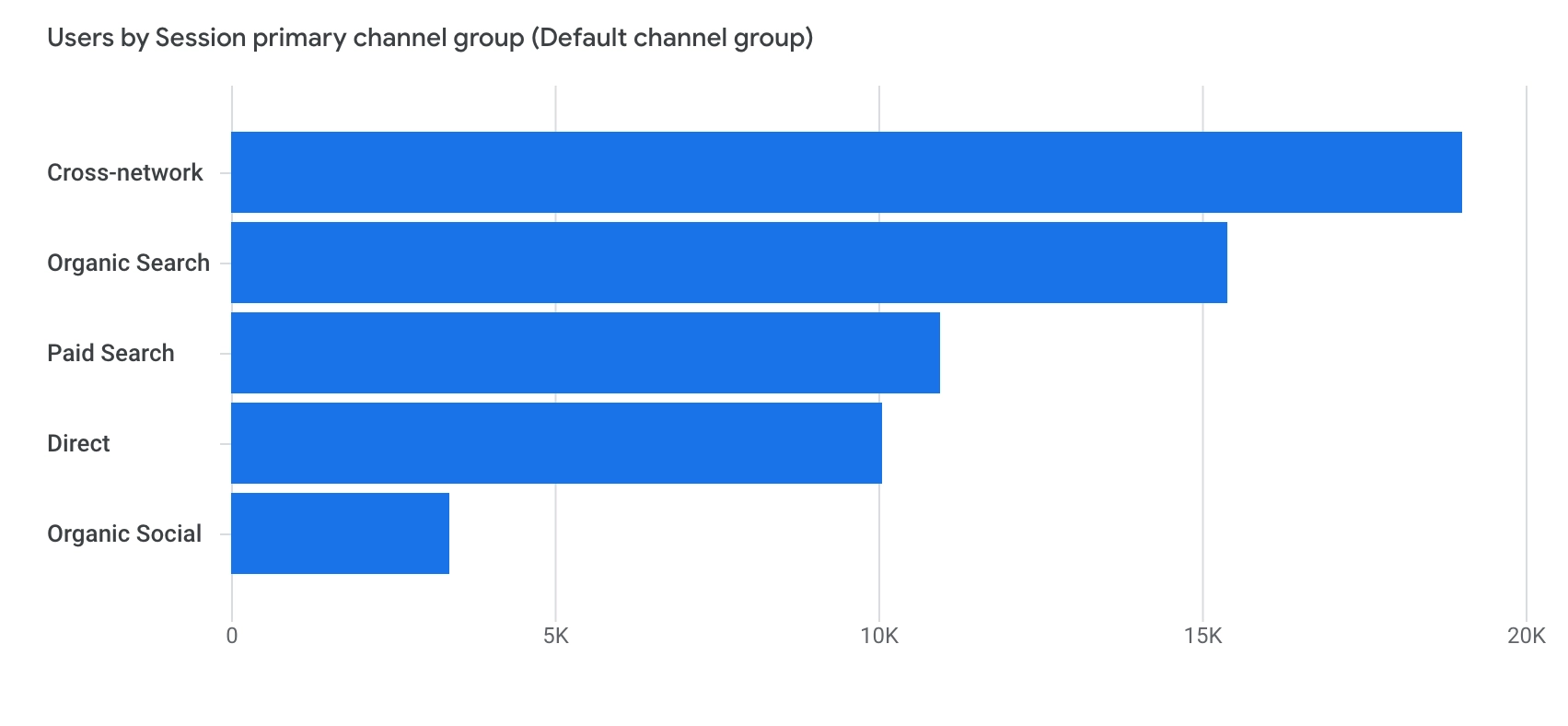
AI is only as good as the data it learns from. Use tools like Google Analytics 4 to gather data on web traffic, user behaviour, and conversion rates. Organise your data by meaningful segments: demographics, purchase history, engagement level, so your AI tools have the right inputs to generate useful outputs.
Google Tag Manager can help streamline your data collection by managing tracking codes efficiently, ensuring you capture all the interactions that matter.
Source: Google Analytics
4. Master Prompt Engineering
If you’re using generative AI tools, the quality of your prompts determines the quality of your results. Prompt engineering is the practice of writing clear, specific instructions that guide AI models towards the output you actually need.
A good prompt includes context (who you are and who your audience is), a specific task, the format you want the output in, and any constraints or tone guidance. The more precise your instructions, the less editing you’ll need to do afterwards.
5. Implement, Test and Iterate
Put your AI tools to work, then measure the results. Use the marketing analytics available on your platforms to track whether AI-assisted campaigns outperform your previous approach.
Adjust your prompts, targeting settings, or automation workflows based on what the data tells you. Effective marketing with AI is iterative, the more feedback you give your tools, the better they perform.
Real-World Example: The SunShine Co.
The SunShine Co. is a great example of how AI can enhance marketing and customer service for a growing business.
By integrating AI with their app and ecommerce platform, they streamlined booking sunbed appointments, automated personalised email marketing workflows, and improved customer service with AI chatbots.
The result was higher customer engagement, smoother operations, and a much more satisfying user experience.

Source: The SunShine Co.
AI Marketing Tools Worth Knowing in 2026
The market for AI marketing tools has grown enormously. Here are some categories and examples worth exploring. AI is also starting to shape influencer marketing, with tools that identify the best-fit creators for your audience based on engagement data rather than follower count alone:
- CRM and marketing automation: HubSpot, our own Nexus CRM, ActiveCampaign.
- Content and generative AI: ChatGPT, Claude, Jasper, Copy.ai.
- SEO and content optimisation: SERanking, Surfer SEO, Semrush’s AI features.
- Social media management: Buffer, Hootsuite (with AI assist), Metricool.
- Paid advertising: Google Ads (Performance Max), Meta Advantage+.
- Analytics and predictive tools: GA4, Hotjar (AI summaries), Klaviyo for ecommerce.
No single tool does everything. The strongest AI marketing stacks combine a few well-integrated tools rather than trying every new platform that launches.

Source: Nexus
Benefits and Challenges of AI in Marketing
| ✅ Benefits | ⚠️ Challenges |
|---|---|
| Increased Efficiency | Data Quality |
| Personalisation at Scale | Legacy Tech Limitations |
| Smarter Decision-Making | Data Privacy & Compliance |
| Improved Customer Experience | Over-Reliance on AI Output |
| Lower Cost Per Acquisition | Training Time |
For further reading on each point:
Benefits
- Increased Efficiency: Automates time-consuming, repetitive tasks, freeing your team for strategic and creative work.
- Personalisation at Scale: Delivers tailored content, messaging, and offers to each customer based on their actual behaviours and preferences.
- Smarter Decision-Making: Real-time data and predictive analytics inform better decisions faster.
- Improved Customer Experience: Faster responses, more relevant recommendations, and seamless journeys across every channel.
- Lower Cost Per Acquisition: AI-optimised advertising and email workflows typically reduce wasted spend over time.
Challenges
- Training Time and Data Quality: Requires high-quality data and time for training to avoid inaccurate predictions.
- Legacy Models with Tech Limitations: Integrating AI with outdated systems can be challenging.
- Data Privacy and Security Risks: Managing data privacy and security is crucial when using extensive data for AI. GDPR obligations need careful management in the UK
The Future of AI in Marketing
The pace of innovation in AI shows no signs of slowing. Over the next few years, AI agents will move from experimental to mainstream, handling entire marketing workflows autonomously, from briefing content to reporting on results.
Hyper-personalisation will become a baseline customer expectation rather than a differentiator, with AI technologies tailoring experiences in real time across every channel.
AI-assisted search is already changing how people find businesses online, making it essential for marketers to think beyond traditional SEO. If you want to stay ahead of that shift, our AI SEO service is a good place to start.
FAQs About AI in Marketing
How is AI used in marketing?
AI is used across virtually every area of marketing, from writing content and managing email campaigns, to automating paid advertising bids, personalising website experiences, analysing customer data, and powering chatbots.
The most common marketing use cases are content creation, email personalisation, social media management, predictive analytics, and advertising optimisation.
What are the 5 ways AI can be used for marketing?
The five most impactful ways businesses are using AI in their marketing right now are: (1) content creation and copywriting, (2) email marketing personalisation and automation, (3) paid advertising optimisation through smart bidding and targeting, (4) customer service via conversational AI and chatbots, and (5) predictive analytics for audience segmentation and campaign planning.
What is the 3-3-3 rule in marketing?
The 3-3-3 rule is a content framework suggesting that in any piece of marketing, you should address three problems your audience faces, present three ways your product or service solves them, and end with three reasons to take action now. It’s a useful structure for AI prompts, giving the model a clear framework to work within when generating marketing messages.
What are the 4 types of AI?
In a marketing context, the four main types of AI are: analytical AI (understanding past data), predictive AI (forecasting future behaviours), conversational AI (chatbots and virtual assistants), and generative AI (creating original content from prompts). Most modern AI marketing platforms combine more than one of these capabilities.
Transform Your Marketing Strategy with AI in 2026
AI in marketing isn’t a trend to wait on, it’s already reshaping how businesses compete online.
The good news is that many of the most powerful tools are accessible to businesses of any size, and the barriers to getting started are lower than ever.
Whether you’re looking to produce better content, run smarter email campaigns, improve your paid advertising performance, or build automated marketing workflows that scale with your business, AI can help you get there faster.
At Design Box, we help businesses across the UK put AI to work in their marketing strategies in a way that’s practical, measurable, and built around their specific goals. If you’re ready to explore what AI could do for your business, get in touch with us today.